
The 5 Best Hand Dynamometers [Ranked]

Hand dynamometers are handheld medical devices used to measure grip strength — how hard you can squeeze with your hand and forearm muscles.
They’re a standard tool in physical therapy clinics and sports performance labs, and they’ve become popular for home rehab tracking too. Grip strength isn’t just about opening jars: research reviewed by the National Institutes of Health has found hand-grip strength to be a meaningful predictor of overall physical function, and it’s used clinically to track recovery after surgery, injury, or neuromuscular conditions (Source).
This guide covers the current best-selling hand dynamometers, how hydraulic and digital models differ, and what actually matters when choosing one.
At a Glance: Which Hand Dynamometer Do You Need?
- For clinical or rehab use: a hydraulic dynamometer — the design most physical therapy clinics still use as their reference standard.
- For home tracking or general fitness: a digital model — easier to read at a glance, and many store past readings automatically.
- For athletes and coaches: a digital model with adjustable resistance , so you can track grip strength trends across a training season.
- For smaller hands or pediatric/occupational therapy use: look specifically for an adjustable handle with a lower grip-span range.
The 5 Best-Selling Hand Dynamometers Right Now

- [Accurate Measurement] - This hand Grip Strength Tester is equipped with a high-precision strain gauge sensor for accurately measuring Grip Strength up to 198 pounds with the division of 0.2lbs / 0.1kgs. 2* AAA batteries included; *Take note of the battery polarities when installing and replacing batteries.

- [Track Your Progress with Precision] – Know exactly where you stand. Measures grip strength up to 265lbs (120kg) with 0.1kg accuracy—so you can see real improvements week by week. Whether you're recovering from an injury or training for competition, you'll have the data to stay motivated.
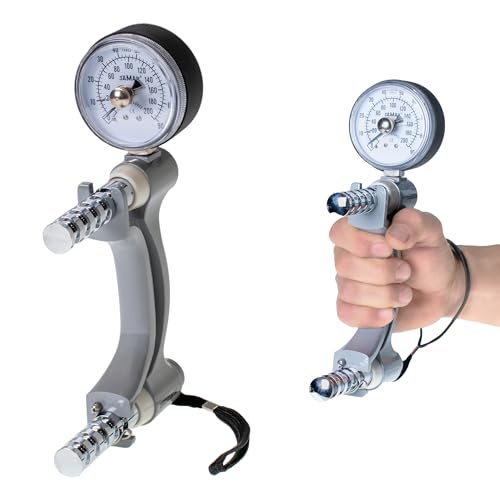
- PROFESSIONAL-GRADE GRIP TESTING TOOL: Measures hand strength with clinical accuracy using a hydraulic system; ideal for rehab, fitness training, or medical evaluations; trusted by doctors, therapists, and trainers

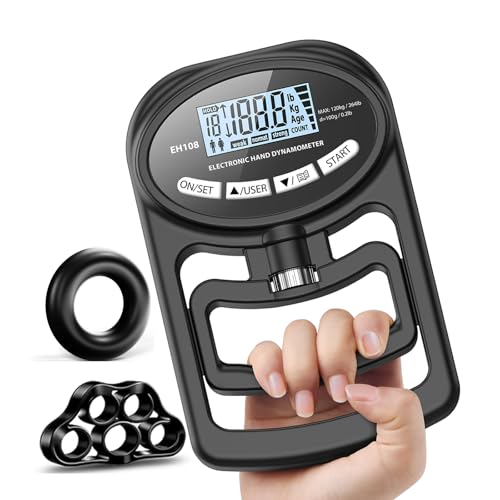
- True 3‑in‑1 Grip System:train and test in one kit. Finger expander + palm ring build finger and palm power, while the digital grip strength tester tracks your progress. More complete than single‑tool sets, this Dynamometer grip strength trainer boosts results
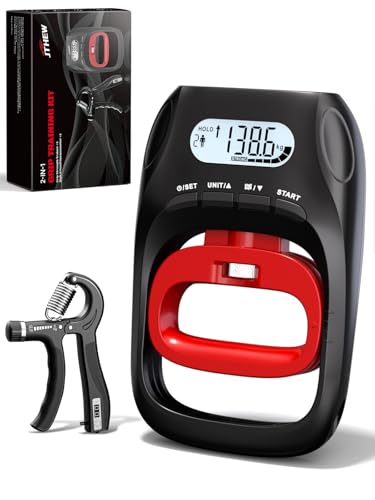
- [Dual-Function Grip Enhancer]This set integrates a high-precision grip strength tester with an adjustable resistance grip trainer, comprehensively meeting your needs for measuring and improving grip strength
Hydraulic vs. Digital: How to Choose
 Grip strength is trainable — a dynamometer just gives you an objective number to track it by.
1. Hydraulic dynamometers
Hydraulic models use a sealed, fluid-filled gauge that registers grip force on an analog dial. They’re mechanically simple, need no batteries, and hold calibration well over years of use — which is why they remain the standard in most clinical settings.
The tradeoff is that reading an analog dial precisely takes a bit more attention than glancing at a digital number, and they don’t store a history of past readings on their own.
2. Digital dynamometers
Digital models use an internal strain-gauge sensor and show your result as a number on a screen. Most can store readings for multiple users and some will show whether a result is trending up or down compared to your last test.
They’re the better pick if you’re tracking your own progress over time, or if multiple people in a household or gym are using the same unit and want separate records.
3. Grip range and handle size
Most dynamometers, hydraulic or digital, measure up to roughly 200 lbs (90 kg) of grip force with an adjustable handle to fit different hand sizes. If you’re buying for a smaller hand — a child, or someone with significant hand atrophy — check that the handle adjusts down far enough; not every model does.
4. Who typically uses one
- Physical and occupational therapists tracking rehab progress after surgery, stroke, or injury
- Athletes and strength coaches in sports where grip matters — climbing, baseball, tennis, grappling
- Researchers and clinicians, since grip strength is increasingly used as a general marker of physical health in older adults
- Anyone doing at-home grip or forearm strength training who wants an objective way to track progress
Hand Dynamometer Types Compared
| Type | How It Works | Typical Grip Range | Best For |
|---|---|---|---|
| Hydraulic | Sealed fluid gauge, analog dial | 0–200 lbs / 0–90 kg | Clinical/PT use, no batteries, long-term calibration |
| Digital (basic) | Strain-gauge sensor, digital display | 0–200 lbs / 0–90 kg | Home tracking, easy-to-read results |
| Digital (data-logging) | Strain gauge + internal memory | 0–200 lbs / 0–90 kg | Athletes and coaches tracking progress over time |
| Adjustable/compact | Narrower handle-span range | Lower range, smaller grip span | Smaller hands, pediatric or occupational therapy use |
How to Get an Accurate Reading
Technique affects your number more than people expect — the same person can post noticeably different results depending on posture and arm position. The American Society of Hand Therapists’ standardized protocol calls for a seated position, shoulder relaxed, elbow at 90 degrees, and forearm in a neutral position (Source). A few basics that keep readings consistent test to test:
- Sit upright with your shoulder relaxed, elbow bent at roughly 90 degrees, and forearm in a neutral position (not twisted palm-up or palm-down).
- Keep your arm close to your body rather than braced against a table or your leg — bracing inflates the reading.
- Squeeze in one smooth, maximal effort rather than a slow ramp-up.
- Test both hands and take 2–3 readings per side, since results can vary test to test — most people use the average or best of three.
- Retest under the same conditions each time (same time of day, same posture) if you’re tracking progress, since fatigue and time of day both shift results.
Watch: Proper Grip Strength Testing Technique
If grip strength is part of a broader rehab or training plan, a finger exerciser is a natural complement for building the muscles a dynamometer measures, and a force gauge is worth a look if you need push/pull force measurement beyond grip strength specifically.
Hand Dynamometer FAQ
Hydraulic or digital — which is more accurate?
Both are considered clinically valid when calibrated correctly. Hydraulic gauges are the longstanding clinical reference; digital models are just as accurate for most practical purposes and are easier to read and log.
What’s a “normal” grip strength?
It varies widely by age, sex, and hand dominance, so there’s no single normal number — the more useful approach is tracking your own trend over time rather than comparing to a generic average.
Do I need to test both hands?
Yes, if you want a complete picture — dominant-hand grip is typically somewhat stronger, and a large or worsening gap between hands can itself be clinically relevant.
How often should I retest?
For rehab tracking, weekly or biweekly is common. For general fitness tracking, monthly is usually enough to see a meaningful trend.
Do these need calibration?
Hydraulic units rarely need adjustment but can drift over years of heavy use. Digital units typically don’t require manual calibration, but check the manufacturer’s guidance if your readings seem inconsistent.
The Bottom Line
For most home users and general fitness tracking, a digital hand dynamometer is the easiest to use and gives you a stored history to track progress against. If you’re in a clinical or rehab setting — or you just want the tool most physical therapists trust — a hydraulic model is the safer, longer-lasting choice.
Whichever type you choose, consistent technique matters more than the specific unit: same posture, same arm position, same time of day, every time you test.