
The 5 Best Portable Hydrogen Sulfide Monitors [Ranked]

Portable hydrogen sulfide monitors detect a gas that can kill a worker before they even realize it’s there.
Hydrogen sulfide, often called H2S or “sewer gas,” is colorless and highly toxic.
At low concentrations it smells like rotten eggs.
At the concentrations that actually matter for safety, you can’t smell it at all — which is exactly why relying on your nose is not a safety strategy.
At a Glance: Which H2S Monitor Do You Need?
- For individual worker use: a compact, No products found. with audible and visual alarms.
- For confined space entry: a monitor with pre-entry testing capability, since OSHA requires atmospheric testing before entry.
- For multi-gas environments: consider a multi-gas monitor covering H2S alongside oxygen, combustible gases, and CO, rather than a single-gas unit.
- For long shifts: check battery life specifically — a monitor that dies mid-shift defeats the purpose.
The 5 Best-Selling Portable Hydrogen Sulfide Monitors Right Now

- Hibernation mode with case accessory or IntelliDoX
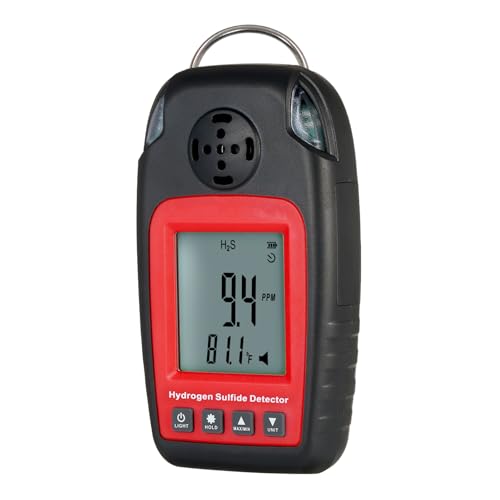
- ✅【Buzzer & Red Light Alarm】: The H2S Monitor emits high decibel buzeer and flash red light constantly when the h2s ppm value reach the threshold, you may manually configure high and low alarm threshold value

- Zero Maintenance Gas Detector: World's most popular and widely used gas detector that requires no maintenance throughout its lifespan
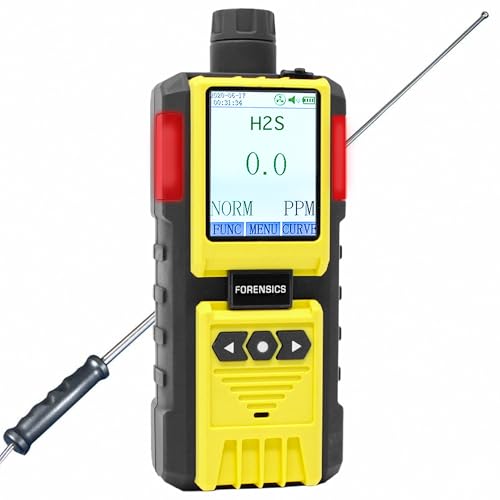
- 🎆 DETECT: Hydrogen Sulfide Analyzer measuring 0 -100 ppm with 0.1 ppm resolution with built-in pump for super fast detection. Comes USA NIST traceable calibrated from Los Angeles, CA.
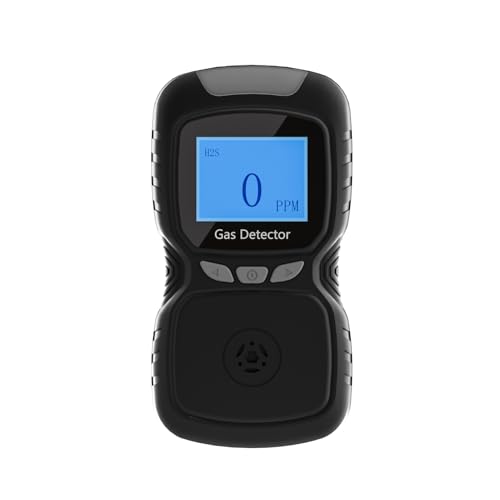
- H2S DETECTION: This portable single gas detector is specifically designed to detect hydrogen sulfide (H2S) gas with a wide measurement range of 0–100 ppm.
Why You Can’t Just Rely on Smell
This is the single most important thing to understand about H2S exposure.
At low concentrations, H2S has a distinct rotten-egg odor that most people can detect.
But at higher, genuinely dangerous concentrations, it causes rapid olfactory fatigue — your sense of smell shuts down within minutes, and you lose the ability to detect the gas entirely, right when it matters most.
At concentrations around 100 ppm, exposure can cause immediate collapse and, without rescue, death (Source).
This is exactly why continuous, instrument-based monitoring exists — your nose is not a reliable warning system once concentrations get high enough to actually hurt you.
OSHA and NIOSH Exposure Limits
| Standard | Limit | Meaning |
|---|---|---|
| OSHA PEL (ceiling) | 20 ppm | Must never be exceeded at any point during exposure |
| OSHA acceptable peak (oil/gas) | 50 ppm for 10 minutes | Allowed briefly, once per shift, with no other exposure |
| NIOSH REL (ceiling) | 10 ppm | More conservative recommended limit |
| NIOSH IDLH | 100 ppm | Immediately dangerous to life or health |
These aren’t arbitrary numbers — they’re based on documented physiological effects at each concentration threshold (Source).

Recognizing Exposure Symptoms
Knowing the warning signs matters even with a monitor in use, since equipment can fail and situations change quickly.
- Low-level exposure: eye, nose, and throat irritation, headache, and the characteristic rotten-egg smell — while you can still smell it.
- Moderate exposure: more severe irritation, dizziness, nausea, and breathing difficulty.
- High exposure: loss of smell (a critical warning sign, not a relief), and rapidly worsening symptoms.
- Extreme exposure: immediate collapse, respiratory failure, and death — this can happen within a single breath at high enough concentrations.
If a monitor alarms or you notice these symptoms, treat it as a genuine emergency — evacuate immediately rather than trying to assess the situation from inside the affected area.
Who Actually Needs One
- Wastewater and sewer workers — H2S is generated by decomposing organic matter, making sewage systems a primary exposure source.
- Oil and gas industry workers — H2S occurs naturally in many drilling and extraction environments.
- Confined space entrants of any kind — OSHA’s permit-required confined space standard mandates atmospheric testing before entry specifically because gases like H2S can accumulate undetected (Source).
- Agricultural workers handling manure storage and processing, another significant H2S source.
- Pulp and paper industry workers, where certain processes generate H2S as a byproduct.
Single-Gas vs. Multi-Gas Monitors
Single-gas H2S monitors
Simpler, typically less expensive, and focused entirely on H2S detection.
A reasonable choice if H2S is genuinely the only gas hazard relevant to your specific work environment.
Multi-gas monitors
Cover H2S alongside other common hazards — typically oxygen level, combustible gas (LEL), and carbon monoxide.
Many confined space environments have multiple potential hazards simultaneously, which is exactly the scenario multi-gas monitors are built for.
If there’s any realistic chance of oxygen deficiency or other gas hazards alongside H2S, a multi-gas unit is the safer default, not just an upsell.
Watch: H2S Gas Monitors Introduction
Confined Space Entry: The Testing Sequence Matters
Atmospheric testing before confined space entry isn’t just a formality — the order of testing is specific for a reason.
OSHA’s standard requires testing for oxygen content first, then flammable gases, and finally toxic gases like H2S, since an inaccurate oxygen reading can throw off the accuracy of other sensor readings (Source).
A personal H2S monitor worn during the work itself is a separate, ongoing layer of protection — it doesn’t replace the pre-entry testing step, and treating it as a substitute for a proper permit-required confined space protocol is a common and dangerous shortcut.
Re-testing is also required if entry is interrupted or if conditions could plausibly have changed, rather than relying on a single reading taken at the start of a shift.
Sensor Life and Why Monitors Need Replacing
Electrochemical H2S sensors, the type used in most portable monitors, have a limited working life and gradually lose sensitivity even with proper calibration.
Manufacturers typically specify an expected sensor lifespan, after which readings can become unreliable even if the monitor still powers on and appears to function normally.
This is a real, ongoing cost to factor in beyond the initial purchase price — a monitor with an expired or degraded sensor can give a false sense of security, which is arguably worse than having no monitor at all.
Following the manufacturer’s replacement schedule, not just waiting for a monitor to visibly fail, is the safer approach in any workplace where H2S exposure is a genuine risk.
What to Look For
- Alarm type. Audible, visual, and vibration alarms together ensure you notice an alert even in a loud or visually busy environment.
- Bump test and calibration requirements. A monitor needs regular bump testing and periodic calibration to remain reliable — factor this into your actual ongoing cost and workflow, not just the purchase price.
- Battery life and type. Confirm it covers your full shift length, with rechargeable vs. replaceable battery being a real practical tradeoff.
- Durability rating. Look for an appropriate IP rating for dust and water resistance given your specific work environment.
- Data logging. Useful for compliance documentation and incident investigation, particularly in regulated industrial settings.
Portable H2S Monitor FAQ
How often does an H2S monitor need calibration?
This varies by manufacturer and use intensity, but regular bump testing (a quick functional check) and periodic full calibration are both standard requirements — follow the specific manufacturer’s schedule rather than guessing.
Can I rely on smell instead of a monitor?
No. Olfactory fatigue at higher concentrations means your sense of smell can’t be trusted at exactly the exposure levels that matter most.
Do I need a multi-gas monitor or is single-gas enough?
If H2S is genuinely your only realistic gas hazard, single-gas is reasonable. If there’s any chance of oxygen deficiency or other gas hazards in the same environment, multi-gas is the safer choice.
What should I do if my monitor alarms?
Follow your organization’s specific emergency procedures immediately — this typically means evacuating the area and not re-entering until atmospheric conditions are confirmed safe.
Is a personal monitor enough, or do I need separate atmospheric testing equipment too?
For confined space entry specifically, OSHA requires pre-entry atmospheric testing in a specific order (oxygen, then flammables, then toxics) — a personal monitor for continuous wear during work is a separate, additional layer, not necessarily a full substitute for a proper pre-entry testing protocol.
The Bottom Line
H2S is genuinely dangerous, and the specific danger — that you lose the ability to smell it right when concentrations become life-threatening — is exactly why instrument-based monitoring isn’t optional caution, it’s the actual safety mechanism.
Match the monitor to your specific hazard profile, keep it calibrated, and treat every alarm as real until proven otherwise.