
The 5 Best Bottle Cutters [Ranked]

Bottle cutters score a clean line around a glass bottle so it separates cleanly into two pieces instead of shattering.
The result is a bottle bottom that becomes a candle holder, a drinking glass, a vase, or a dozen other upcycled projects, with the neck section useful for its own set of crafts.
It’s a genuinely satisfying hobby once you get the technique down, and one of the more approachable ways to turn glass you’d otherwise recycle or toss into something you actually use.
At a Glance: Which Bottle Cutter Do You Need?
- For beginners: a premium bottle cutter kit with a full accessory set makes the learning curve easier.
- For a wide range of bottle sizes: confirm the cutter’s adjustable range covers everything from standard wine bottles to smaller jars.
- For durability: metal-bodied cutters generally hold their calibration better over repeated use than plastic-frame models.
- For finishing work: make sure your kit includes or you separately buy sandpaper or a sanding tool, since a raw cut edge isn’t safe to use as-is.
The 5 Best-Selling Bottle Cutters Right Now

- 【UPGRADED STRUCTURAL DESIGN & FEATURES】 This bottle cutter includes 5 support wheels created specifically to better stabilize the bottle, 2 ultra-strong diamond carbide blade guaranteed for over 400,000 cuts, built with stable and solid made of stainless steel bottom plate to the highest quality standards you should expect.

- PERFECT SCORING; Our glass bottle cutter tool kit set contains Premium Glass Cutter for Bottles and Glass Cutting Oil 10ml. Glass Bottle Cutter contains two different sizes of cutting heads, 3-6mm and 6-12mm, you can cut different thicknesses glass bottles. The blade is made of the hardest hard alloy, can achieve the most perfect cutting effect. Glass cutting oil can prolong life of your cutter blade. Perfect self-sharpening effect on the blade can improve the cutting force of the blade.

- PERFECT SCORING; Our glass bottle cutter set contains two different sizes of cutting heads, 3-6mm and 6-12mm, you can cut different thicknesses glass bottles. The blade is made of the hardest hard alloy, can achieve the most perfect cutting effect.
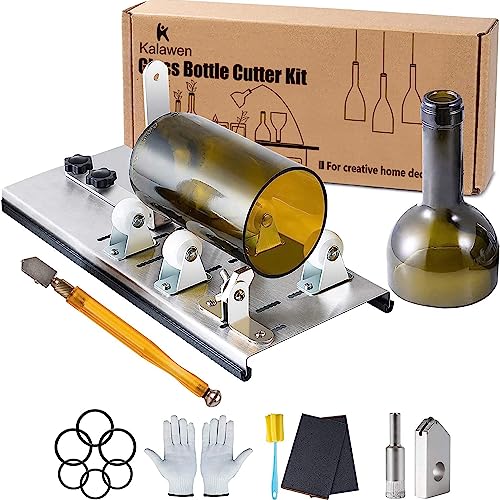
- 【Glass Bottle Cutter Upgrade】- The glass bottle cutter design includes 5 support wheels created specifically to better stabilize the bottle, for a more precise cutting. In addition,the bottom plate of the glass bottle cutter is upgraded to stainless steel material and we have upgraded all accessories to be adjustable and added a spare blade, which can cut more than 400,000 times, which can extend the service life of this product

- 【Double Banner Design】 This glass bottle cutter adopts a new double baffle solid structure, which is more stable than the old model, reduces shaking and sliding, and makes the cutting process safer and more controllable. Greatly improve the safety and convenience in the process of use.Note: When cutting, simply rotate the bottle once—there is no need to make back-and-forth cuts to deepen the scratch. Otherwise, the cut will be uneven.
Safety First: Glass Cutting Isn’t a No-Risk Craft
This deserves real attention before you make your first cut.
Freshly cut and scored glass edges are genuinely sharp, and proper hand protection matters — OSHA’s hand protection standard specifically requires evaluating the right protective equipment for the actual hazard involved, and cut-resistant gloves rated for sharp materials are the appropriate choice here (Source).
Eye protection matters just as much as glove protection — small glass chips can flake off during scoring and breaking, and safety glasses are a genuinely necessary precaution, not an optional extra.
Glass manufacturers who specialize in cutting techniques emphasize a clean, single, confident score rather than repeated scoring attempts, since multiple score lines multiply the chance of an uncontrolled, jagged break with sharper resulting edges (Source).
Work on a stable, clear surface, keep kids and pets out of the immediate work area while cutting, and don’t rush the sanding step at the end — a properly smoothed edge is what actually makes the finished piece safe to handle and use.
How Bottle Cutting Actually Works
The process relies on a genuinely simple principle: a controlled scratch plus a controlled temperature change.
First, the cutter’s wheel scores a thin, even line around the bottle’s circumference while it’s held in the adjustable frame.
That score line creates a weak point in the glass. Applying alternating heat and cold — commonly hot water followed by cold water, or a candle flame followed by ice — causes the glass to expand and contract unevenly right along that score line, causing a clean separation exactly where you scored it.
The bottom section then needs sanding, typically starting with a coarser grit to remove the roughest edge and moving to progressively finer grit for a smooth, safe-to-handle finish.
Bottle Cutter Types Compared
| Type | Frame Material | Best For |
|---|---|---|
| Basic adjustable cutter | Plastic or lightweight metal | Beginners, occasional use |
| Premium kit with accessories | Metal, includes isolation rings and grinding tools | Regular crafters wanting a complete setup |
| Neck cutter | Metal, designed for the bottle neck specifically | Separate projects using the neck section |
| Rotary jig-style cutter | Metal frame with rotating bottle cradle | More consistent, repeatable scoring for volume projects |

Why This Is a Genuinely Worthwhile Hobby, Not Just a Novelty
There’s a real sustainability angle here beyond the craft appeal.
Glass containers had a recycling rate of just 31.3% nationally as of the EPA’s most recent comprehensive figures, meaning a large share of glass that could be reused or recycled ends up in landfills instead (Source).
Repurposing bottles directly at home sidesteps that gap entirely — a bottle that becomes a drinking glass or candle holder never enters the waste stream in the first place.
That’s a genuine, if modest, environmental upside on top of getting a useful, often good-looking finished product.
Watch: How to Cut a Glass Bottle
What to Look For
- Adjustability range. Check that the cutter accommodates the specific bottle diameters you plan to work with, from wine bottles to smaller jars.
- Cutting wheel quality. A durable, replaceable wheel maintains a consistent, clean score over more cuts than a cheap fixed wheel.
- Included accessories. Isolation rings, a grinding stone, and sandpaper save you from separate purchases if you’re starting from scratch.
- Stability during scoring. A cutter that holds the bottle securely while you rotate it produces a more even score than one that shifts.
- Instructions quality. Since technique matters as much as the tool, a kit with clear, detailed instructions is genuinely worth prioritizing for first-time users.
Common Problems and Fixes
The bottle won’t separate cleanly
Usually caused by an inconsistent score line — if the depth or pressure varied as you rotated the bottle, the break will follow the path of least resistance rather than your intended line.
Practice on a few sacrificial bottles before attempting a piece you actually want to keep.
Jagged or uneven edges after breaking
This often comes from too much heat/cold temperature difference applied too quickly, or an incomplete score line.
A more moderate temperature difference and a fully continuous score generally produce a cleaner separation.
The cutting wheel isn’t scoring deeply enough
Check that the wheel is making full contact with the glass at a consistent pressure throughout the full rotation, and confirm the wheel itself isn’t worn or dull from repeated use.
Project Ideas to Get You Started
Once you’ve got a clean cut down, the range of projects is genuinely wide.
Bottle bottoms make natural drinking glasses, candle holders, succulent planters, or terrariums with just the sanding step separating a raw cut from a finished piece.
The neck sections aren’t waste, either — they work well as small vases, oil dispensers, or even reworked into their own smaller decorative pieces with additional cutting.
Colored glass bottles, in particular, hold up well as standalone decor pieces or grouped together, since the color does most of the visual work without needing additional finishing.
For gifting, a set of matching hand-cut glasses from bottles with personal significance — a couple’s favorite wine, a milestone celebration bottle — tends to land better than a generic store-bought item.
Who Actually Benefits Most
- Craft and DIY hobbyists — a genuinely satisfying skill with a wide range of practical finished projects.
- Anyone interested in sustainable/upcycled decor — a direct way to keep glass out of the waste stream while making something usable.
- Wine and craft beer enthusiasts — a natural way to repurpose bottles that would otherwise just accumulate or get recycled.
- Gift-makers — hand-cut glassware and candle holders make distinctive, personalized handmade gifts.
Bottle Cutter FAQ
Is bottle cutting difficult to learn?
There’s a real learning curve, and your first few attempts may not break cleanly — most people improve significantly after a handful of practice cuts.
What bottles work best?
Bottles with a flat bottom and relatively consistent wall thickness work most reliably — wine bottles, beer bottles, and many jars are common starting points.
Do I need special tools beyond the cutter itself?
Yes — you’ll need a heat source (hot water or a candle), a cold water source, and sandpaper or a grinding tool for finishing edges, in addition to basic safety gear.
Is it safe to drink from a cut bottle glass?
Only once the cut edge is fully and smoothly sanded — an unfinished edge is genuinely sharp and unsafe for that use until properly finished.
Can any glass bottle be cut, including patterned or curved ones?
Heavily curved, tapered, or irregularly shaped bottles are significantly harder to score evenly — flatter-sided, cylindrical bottles are the more forgiving starting point.
The Bottom Line
A bottle cutter turns a genuinely simple mechanical principle — a controlled score plus a controlled temperature change — into a legitimately useful and sustainable craft hobby.
Prioritize a stable, adjustable cutter with a durable wheel, take glass safety seriously with proper gloves and eye protection, and don’t rush the sanding step.
If you’re setting up a dedicated space for this and other craft projects, our guide to craft desks is worth a look.

